

Bench to Bedside
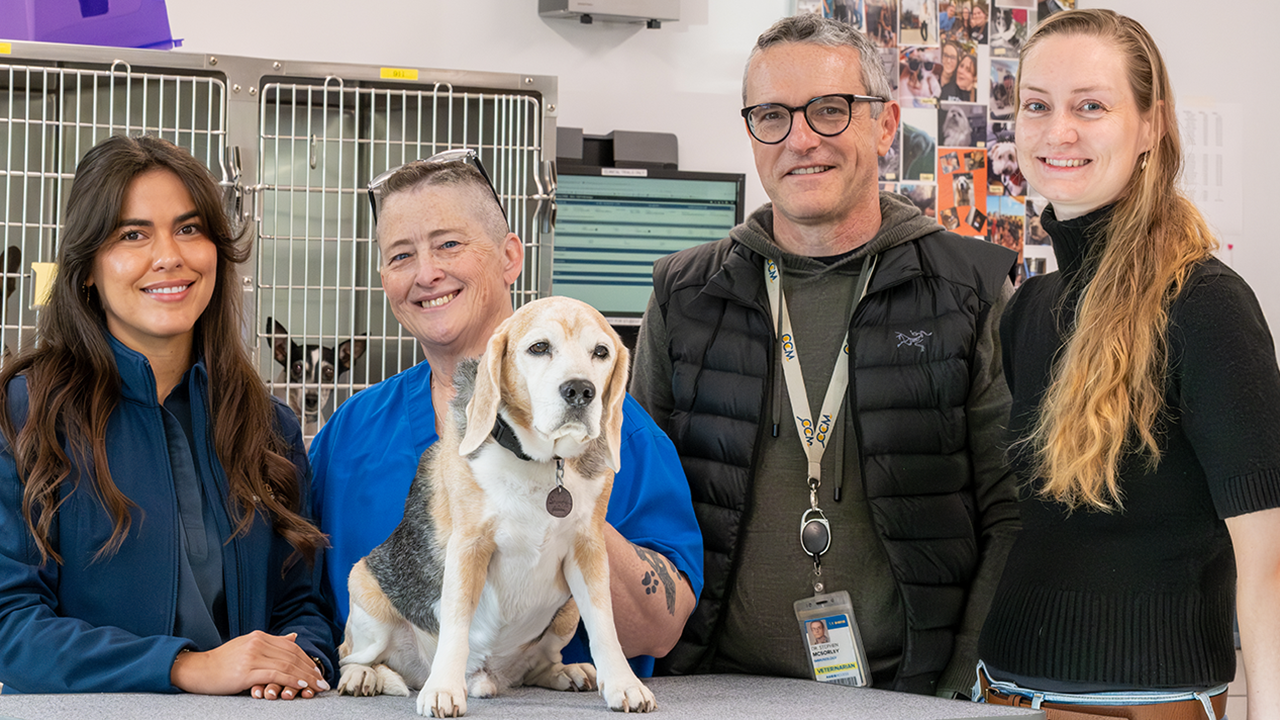
It isn’t often that researchers involved in the fundamental aspects of translational medicine get to meet a patient who has benefitted from a decade or more of basic science. So, when Dr. Stephen McSorley and his postdoctoral researcher Dr. Marietta Ravesloot-Chavez met Snoopy on the last day of his clinical trial, there were lots of ear scratches to deliver.
“We’re often stuck in the lab, thinking about details to make the research better,” said McSorley. “We don’t often get to see a patient go through a clinical trial and actually see it work. This is pretty fun!”
Snoopy is a 12-year-old beagle who participated in a clinical trial of a novel canine PDL1 antibody made at UC Davis. The trial was created to investigate whether a dog’s own immune system can be recruited to fight metastatic cancer. While similar human PDL1 antibodies have been used to transform treatment and outcomes for some human cancers in the past 15 years, human antibodies generally can’t be used for dogs.
“This was a treatment we knew was helpful in people, now we’re trying to bring that to dogs,” said Dr. Rob Rebhun, one of the veterinary oncologists who serves as a co-investigator for the trial along with Dr. Sami Al-Nadaf.
The idea for developing a canine PDL1 antibody came from a discussion that McSorley had with DVM students in a class more than a decade ago. They asked him if there were innovative immunotherapy treatments for cancer in dogs. That curiosity started a journey of collaboration with Drs. Rebhun, Al-Nadaf, Kent, and many others.
It took several years to create and test the drugs in McSorley’s lab before they could advance to clinical trials. The way these drugs work, McSorley explained, is to remove the brake that a cancer puts on the immune system. A patient mounts an immune response to a disease like melanoma, but when the cancer turns the immune system off, their body can no longer fight the disease.
“All these drugs do is take that brake away and let the patient cure themselves,” McSorley said. “Some patients that don’t respond in human medicine aren’t making a strong enough initial response to the tumor, but if they are making a strong response, and you can take this brake off, they can cure themselves. So basically, Snoopy has been curing himself, he just needed a little bit of help.”
Since the trial launch a year ago, 11 dogs have participated. Eight didn’t respond to treatment; three are continuing in the trial. Snoopy has seen a complete response, meaning the large pulmonary nodules first apparent on his lungs have disappeared in follow-up X-rays and CT scans. Another dog is showing a partial response with tumor shrinkage. And a third is undergoing subcutaneous treatment rather than intravenous.
“Instead of a patient being here for several hours for an infusion and then observation, we’re looking at whether this can be effective if administered under the skin,” said Al-Nadaf. “That reduces the amount of time they need to be in the clinic and could increase quality of life for these patients.”
Rebhun explained why the trial launched with patients with very advanced clinical cancers. “If you don’t know the risk of a new drug, you start with patients who essentially have nothing to lose,” he said. “That’s why we start with a population with advanced disease and why the results are really impressive so far.”
With proof of concept that PDL1 therapy can help dogs fight cancer, the team seeks to answer: What is the most appropriate dose for the best outcome? Are all dose levels effective? Are there any early signals that the therapy may be working? How well is it tolerated? The team has yet to publish results of this initial study but are hopeful that it will allow grant submissions to further the work and lead to licensed therapy in the future.
This trial and many others are made possible by generous CCAH donors who have been crucial in advancing translational research that can save and prolong quality of life for our companion animals.
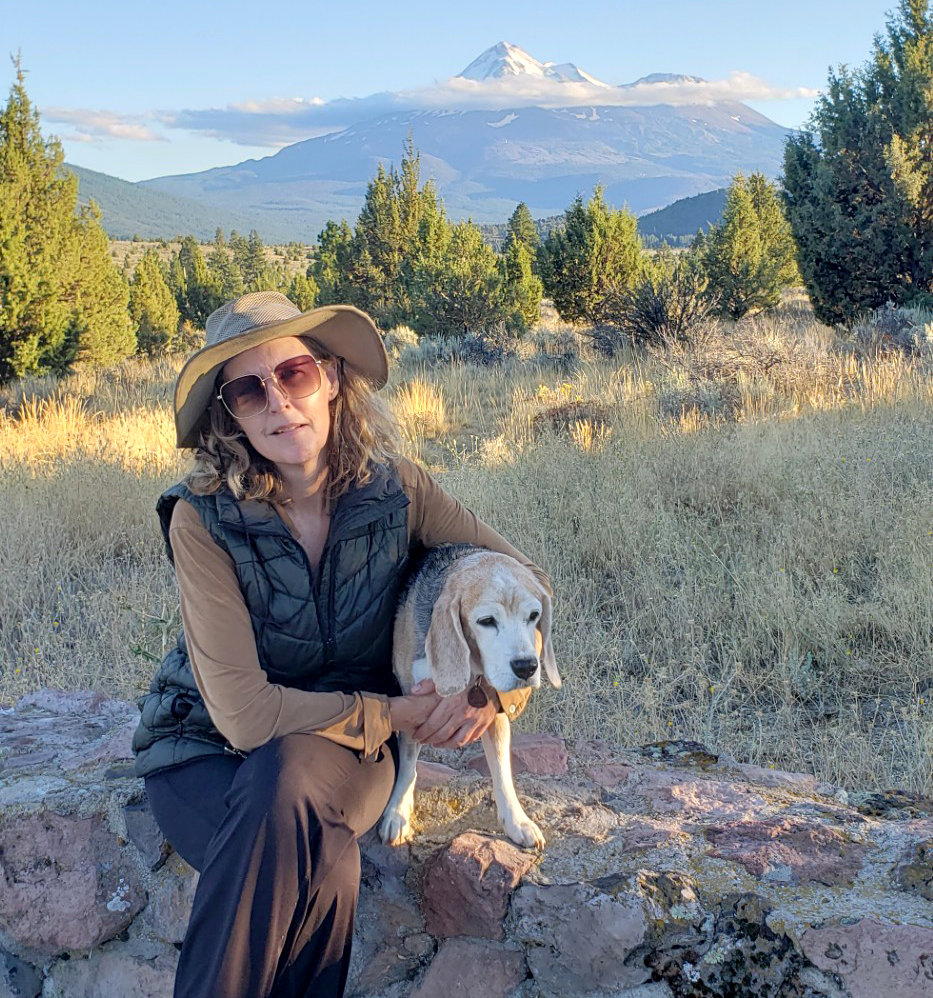
For Snoopy’s owner, Anja Trosbjerg, the results have been nothing short of a miracle. With little expectations going into the trial, Trosbjerg decided to focus on creating memories for her daughter, herself, and Snoopy. They road tripped from their home in Texas to Davis, visiting many beautiful places along the route. In the middle of treatment, they visited Mount Shasta, Crater Lake and the California coast.
“We didn’t know how long we had left with him, so we decided to make the best of it,” she said. “I honestly didn’t expect this therapy to work, so when I saw the report about how big the tumors in his lungs were to start—to disappearing by the fourth infusion—there is no doubt in my mind that a miracle happened. I’m so grateful for the team here.”
UC Davis researchers are actively enrolling four more dogs to receive the subcutaneous treatment of PDL1. For more information about the trial, please contact the Veterinary Center for Clinical Trials: [email protected].