As fall progresses with winter on the horizon, we have several exciting initiatives at the center. I am very excited about launching a new program that focuses on feline health research. UC Davis has a long history of advancing the health of our feline friends, including groundbreaking discoveries in many areas including: nutrition, infectious diseases, cancer, heart disease, kidney disease and longevity.
Researchers identified a genetic variant in the RESF1 gene that is strongly associated with Addison’s disease in Nova Scotia Duck Tolling Retrievers, a serious autoimmune condition that disrupts hormone production and can be fatal without lifelong treatment. Because affected dogs often develop disease at a young age and may also experience other autoimmune disorders, the discovery provides important insight into the inherited nature of the condition. The findings suggest that Tollers may serve as a valuable model for studying autoimmune disease in both veterinary and human medicine, as RESF1 has not previously been linked to Addison’s disease in people. The research also led to the development of a genetic test through the UC Davis Veterinary Genetics Laboratory, giving breeders a tool to reduce the incidence of the disease in future generations while supporting continued advances in comparative medical research.
Anne Marie Messano Petrie has given the gift of a hopeful future to many pet owners by establishing a special fund to advance canine cancer research, all in memory of her beloved Winston, who passed away from hemangiosarcoma in 2025. To honor his memory, and share that enduring love with those who visit the Center for Companion Animal Health, she gifted a mosaic artwork to Dr. Michael Kent and the center.
When dogs suffer severe temporomandibular joint (TMJ) injuries, treatment options can be limited and often result in reduced jaw function or extensive surgical removal of jaw tissue. To address this challenge, Dr. Janny Evenhuis led a research study evaluating two human-designed TMJ plating systems for use in dogs. Supported by CCAH donor funding, the team created and repaired simulated TMJ fractures in canine cadavers and tested the implants under forces comparable to a dog's bite. The study found that both plate designs provided sufficient mechanical strength, offering a promising new option for repairing certain TMJ injuries. Led by the Dentistry and Oral Surgery Service under Dr. Boaz Arzi, this collaborative research advances the field of veterinary oral and maxillofacial surgery and has the potential to improve quality of life for dogs with complex jaw injuries.
Since every dog has its day, it’s only fair that cats have one as well. That day has come at the Center for Companion Animal Health (CCAH) with the launch of a new Feline Health Research Program that will take a multidisciplinary holistic approach to the largest health challenges for cats.
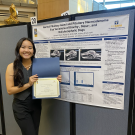
Dr. Hannah Pham graduated in May of this year and is currently continuing her training in a one-year small animal rotating internship at Wheatridge Animal Hospital, a large private veterinary hospital in Denver, Colorado. She plans to apply for residency in radiation oncology. We talked with her about the importance of research support early in her career. During veterinary school she participated in the school’s STAR program (supported in part by the CCAH), which funds mentored research projects carried out by students under the guidance of faculty members.
Margery Pfund was a private person. She and her husband, Gale, were members of the Mendocino community, amongst other areas they called home. They had two black and white cats, Peter and Ivan, who were beloved members of their family and well known by neighbors for their friendly personalities.
Dr. Talya Adler traveled from Israel to California this summer with big goals: tour the nationally ranked UC Davis Weill School of Veterinary Medicine, meet her colleagues at the school's Koret Shelter Medicine Program (KSMP), and collaborate on shared approaches to teaching and supporting shelter medicine.
Two studies expanded understanding of feline infectious peritonitis (FIP) and provided important insights into both disease progression and treatment. Researchers discovered that the virus infects not only macrophages but also key immune cells involved in coordinating immune responses, helping explain the widespread inflammation seen in affected cats and offering clues about why some cats experience relapse after treatment. A second study confirmed remdesivir as an effective treatment option for cats with dry-form FIP, providing veterinarians with an alternative when GS-441524 is unavailable. Together, the findings support improved clinical management of FIP and lay the foundation for future research aimed at reducing relapses and optimizing long-term outcomes.
A study of dogs with congenital portosystemic shunts found that pre-operative EEGs may help predict which patients are at risk for seizures and other serious neurological complications following corrective surgery. The findings suggest EEG screening could enable earlier intervention, more personalized treatment plans, and improved outcomes for dogs undergoing shunt surgery.